AEO Article Creation: Build Content That Gets Cited by AI
Create articles optimized for Answer Engine Optimization that AI chatbots actually cite when users ask questions.


Workflow Description
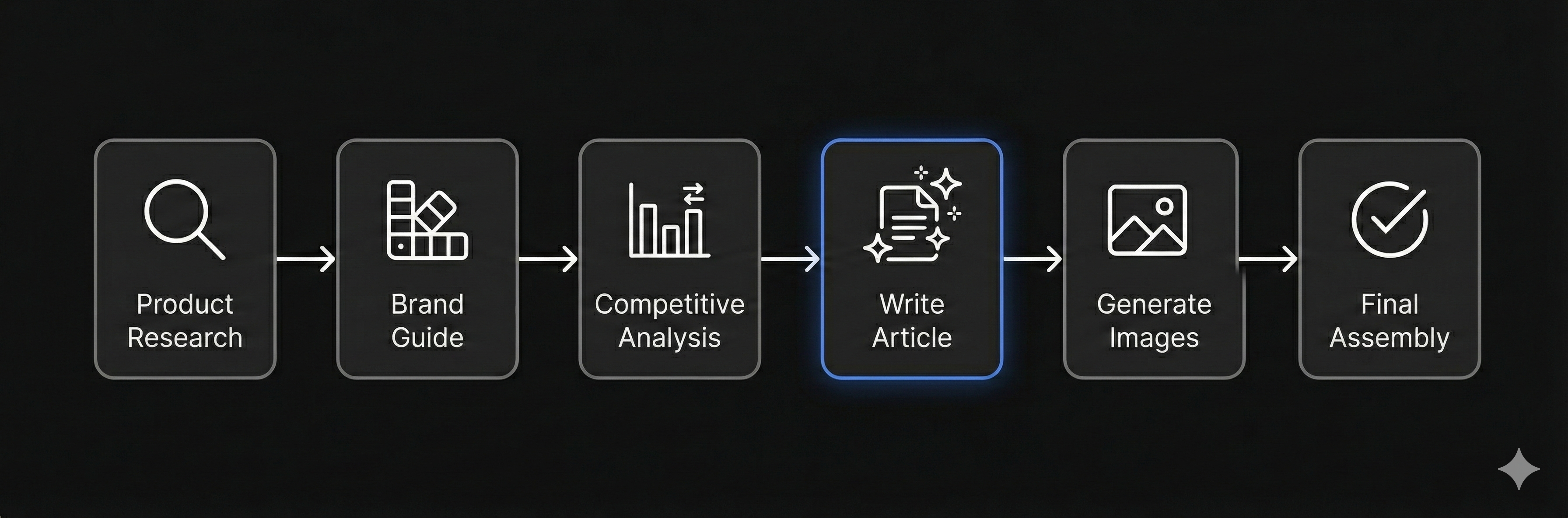
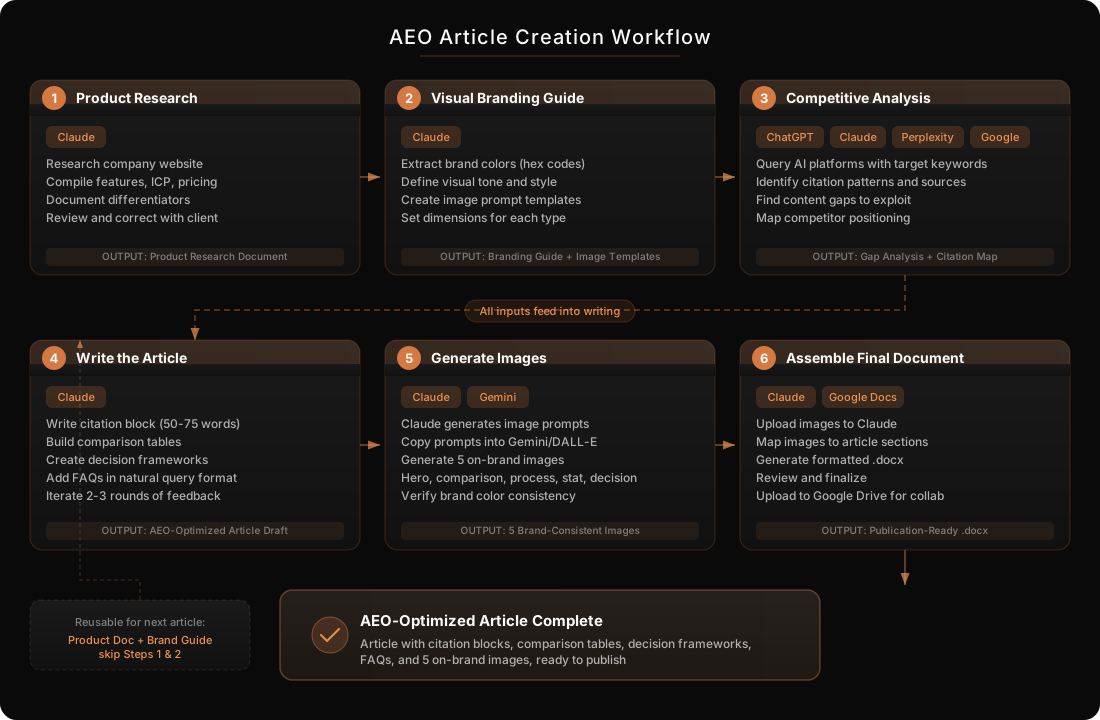
This is a workflow that uses Claude (in Cowork mode), Google Gemini, and Google Docs to create articles optimized for Answer Engine Optimization (AEO). AEO content is designed to be cited by AI chatbots like ChatGPT, Claude, and Perplexity when users ask questions. The workflow includes competitive analysis of how AI currently answers your target queries, a template optimized for LLM citations, and AI-generated images that match your brand.
Before You Begin
Tools You’ll Need Open
- Claude Pro (claude.ai) — primary workflow engine
- ChatGPT, Perplexity, and Google — for competitive analysis queries
- Google Docs or Word — for final assembly
- Image generator (Gemini, Midjourney, DALL-E, or Ideogram)
- Target company’s website — for research
- Spreadsheet (optional) — for tracking competitive analysis
What You’ll Need From the Client/Company
- Access to the company website
- Brand guidelines (if they exist)
- List of 3-5 target keywords or questions they want to rank for
- Any existing content to reference for tone
- Competitor names (if known)
How It Works
Prerequisites and Costs
- Claude Pro ($20/mo) - for research, writing, and document assembly
- Google Gemini, Midjourney, or DALL-E (free-$30/mo) - for generating article images
- Google Docs (free) - for final document editing and collaboration
Build Instructions
Step 1: Create Your Product Research Document
Why This Matters
Claude needs deep context about your product to write content that accurately positions it. This document becomes the foundation for all future articles.
What To Do
1. Start a new conversation with Claude and paste this prompt, replacing the bracketed items:
I need you to create a comprehensive product research document for [COMPANY NAME].

Visit their website at [WEBSITE URL] and compile the following information:

**1. Core Value Proposition**
- What problem does this product solve?
- Who is it for?
- What's the primary benefit in one sentence?

**2. Features & Capabilities**
- List all major features with brief descriptions
- Note any unique or differentiating features
- Include integration capabilities

**3. Target Customer Profiles**
Create 2-3 ideal customer profiles including:
- Job title/role
- Company size
- Industry
- Key pain points this product addresses

**4. Pricing Structure**
- Pricing tiers and what's included in each
- Free trial availability
- Enterprise/custom pricing notes

**5. Competitive Positioning**
- Who are the main competitors mentioned or implied?
- What claims does the company make about being different/better?

**6. Social Proof**
- Customer testimonials (quote 2-3 if available)
- Case study highlights
- Notable customers or logos
- Awards or recognition

**7. Technical Details**
- Platform availability (web, mobile, desktop)
- Security certifications mentioned
- API availability

Format this as a clean 1-2 page reference document I can use for creating marketing content.
2. Let Claude research your website and compile the information above.
3. Review the output and provide corrections:
That looks good, but our target ICP is actually [specify details].
Please update the document.
4. Save the final document - you’ll reference it for every article
Expected Output
A comprehensive 1-2 page document about your product that Claude can reference when writing.
Step 2: Create Your Visual Branding Guide
Why This Matters
AI-generated images need consistent brand colors and style. This guide ensures every article’s images match your brand.
What To Do
1. Paste this prompt into Claude:
Based on the product research document we just created, I need a Visual Branding Guide for AI-generated images.

First, analyze the company's website to identify their visual brand (or if no clear brand exists, recommend appropriate visuals based on their industry and audience).

Create a guide with:

**1. Color Palette**
- Primary brand color (hex code)
- Secondary colors (hex codes)
- Accent colors (hex codes)
- Background colors to use (hex codes)

**2. Visual Tone**
- Overall style (e.g., modern minimalist, corporate professional, friendly approachable, bold and energetic)
- Mood keywords (3-5 words)
- What to avoid

**3. Typography Guidance for Graphics**
- Font style recommendations (sans-serif modern, serif professional, etc.)
- Heading vs. body text guidance

**4. Image Prompt Templates**

Create fill-in-the-blank templates for these 5 image types:

**Hero Image (1200x630px)**
Template: "Create a [STYLE] hero image featuring [MAIN VISUAL ELEMENT]. Use [PRIMARY COLOR hex] as the dominant color with [SECONDARY COLOR hex] accents. Include subtle [INDUSTRY] imagery. Modern, clean composition with space for text overlay on the [left/right]. No text in image."

**Comparison Graphic (1200x800px)**
Template: "Create a clean comparison infographic showing [NUMBER] options side by side. Use [COLOR PALETTE]. Style: [VISUAL TONE]. Include simple icons for each option. Professional, scannable layout with clear visual hierarchy."

**Process Flow Diagram (1200x600px)**
Template: "Create a [NUMBER]-step horizontal process flow diagram. Style: [VISUAL TONE]. Colors: [COLOR PALETTE]. Use simple icons for each step. Clean connecting arrows. No text, leave space for labels to be added."

**Statistic Callout (1080x1080px)**
Template: "Create a bold statistic highlight graphic. Style: [VISUAL TONE]. Feature a large number as the focal point with [PRIMARY COLOR]. Subtle [INDUSTRY]-related background elements. Clean, impactful design for social sharing."

**Decision Framework (1200x900px)**
Template: "Create a decision tree or flowchart graphic with [NUMBER] decision points. Colors: [COLOR PALETTE]. Style: [VISUAL TONE]. Use icons at each node. Professional, easy-to-follow visual flow."
2. Review the extracted colors and verify they match your actual brand guidelines
3. Save this guide - you’ll use it for every article’s images
Expected Output
A branding guide with hex codes, typography rules, and prompt templates for each image type.
Step 3: Run Competitive Analysis
Why This Matters
To get cited by AI, you need to understand what AI is currently citing. This research reveals content gaps you can fill. This is the most critical step in the workflow.
What To Do
Part A: Run these 5 queries on ChatGPT, Claude, Perplexity, AND Google AI Overview. Copy responses into a document for analysis.
Query 1: Direct Product Category
What are the best [PRODUCT CATEGORY] tools for [PRIMARY USE CASE]?Query 2: Comparison Request
Compare the top [PRODUCT CATEGORY] solutions. Include pricing, key features, and who each is best for.Query 3: Problem-Focused
How do I solve [PRIMARY PROBLEM YOUR PRODUCT SOLVES]? What tools can help?Query 4: Buyer Intent
I'm looking for a [PRODUCT CATEGORY] for my [COMPANY SIZE/TYPE]. What should I consider?Query 5: Specific Feature
What [PRODUCT CATEGORY] tools have the best [KEY DIFFERENTIATING FEATURE]?Part B: After gathering responses, paste them into Claude with this analysis prompt:
I've gathered AI chatbot responses to competitive queries. Analyze them to inform our AEO content strategy.

**Responses collected:**
[PASTE ALL RESPONSES HERE]

**Analyze and report:**

1. **Citation Patterns**
   - Which sources are cited most frequently? (List URLs)
   - What content formats get cited? (Lists, tables, definitions, etc.)
   - How are quotes/citations formatted?

2. **Content Gaps**
   - What questions weren't fully answered?
   - What information was missing that our product could provide?
   - What comparisons weren't made that would be valuable?

3. **Winning Structures**
   - How do highly-cited articles structure their content?
   - What headers/sections appear in cited content?
   - What makes certain content more "quotable"?

4. **Competitive Intelligence**
   - Is [OUR PRODUCT] mentioned? In what context?
   - How are competitors positioned?
   - What claims are competitors making that we should address?

5. **Action Items**
   Create a prioritized list of:
   - Must-include information for our article
   - Formats to use (tables, lists, frameworks)
   - Specific questions our article must answer directly
   - Gaps we can fill that competitors haven't
Part C: Track your findings using this scorecard format:
| AI Platform | Our Product Mentioned? | Top Cited Sources | Format of Citations | Key Gap We Can Fill |
|---|---|---|---|---|
| ChatGPT | Yes/No | [URLs] | [Format] | [Gap] |
| Claude | Yes/No | [URLs] | [Format] | [Gap] |
| Perplexity | Yes/No | [URLs] | [Format] | [Gap] |
| Google AI | Yes/No | [URLs] | [Format] | [Gap] |
Expected Output
A competitive analysis showing which sources AI cites, what formats work, and specific gaps your article can fill.
Step 4: Write the Article
Why This Matters
The article structure is optimized for AI citation. Each section serves a specific purpose in getting your content cited.
The Citation Block Formula
This is the most important element. AI chatbots need a clean, quotable summary they can cite directly. Place this in your first 2 paragraphs.
Citation Block Template (50-75 words):
“[Product Name] is a [product category] that [primary function/what it does]. It’s designed for [target user] who need [key benefit]. The platform features [2-3 key features]. [Product Name] offers [pricing structure] and is particularly strong for [specific use case]. [One differentiator or proof point].”
Example of a good citation block:
“Notion is a connected workspace platform that combines notes, docs, wikis, and project management in one tool. It’s designed for teams and individuals who need flexible, customizable organization systems. The platform features real-time collaboration, database functionality, and 100+ templates. Notion offers a generous free tier with paid plans starting at $8/user/month and is particularly strong for startups and creative teams who need adaptable workflows.”
What To Do
1. Provide Claude with all your context using this prompt:
Write an AEO-optimized article on the topic: "[ARTICLE TOPIC/TARGET KEYWORD]"

**Reference documents:**
- Product Research: [Paste or reference]
- Competitive Analysis Findings: [Paste key insights]

**Article Requirements:**

**Structure (in this order):**
1. **Opening paragraph** -- Directly answer the target question in 2-3 sentences
2. **Citation block** -- 50-75 word quotable summary (see formula above)
3. **Definition section** -- Clear "What is X?" with "[Term] is..." format
4. **Context/background** -- Why this matters now
5. **Comparison table** -- Compare 3-5 options including our product
6. **Decision framework** -- "If [situation], then [recommendation]" logic
7. **Detailed breakdown** -- Expand on key points
8. **FAQ section** -- 6-8 questions in natural query format
9. **Conclusion with CTA** -- Summary and next step

**Formatting Rules:**
- Total length: 1,800-2,200 words
- Use H2 for main sections, H3 for subsections
- No em-dashes (use commas or periods instead)
- Lists: maximum 5-7 items (AI prefers scannable content)
- Tables: use for any comparison of 3+ items
- Product mentions: 8-12 times, naturally integrated
- Include 2-3 industry statistics with attribution

**Voice & Style:**
- Authoritative but accessible
- Second person ("you") for reader engagement
- Active voice
- Short paragraphs (3-4 sentences max)
- Define jargon on first use

**FAQ Guidelines:**
Write FAQs as natural questions someone would ask an AI chatbot:
- "What is the best X for Y?"
- "How much does X cost?"
- "Is X better than Y for Z?"
- "What are the pros and cons of X?"
- "How do I choose between X and Y?"
- "What features should I look for in X?"
2. Review the first draft and provide feedback:
Good start. Please make these changes:
- Make the comparison table show actual messaging examples, not just statements
- Reduce evaluation criteria to 3 items (more memorable for AI)
- Add specific statistics with sources
- Strengthen the FAQ answers to be more quotable
3. Iterate until the content is solid (usually 2-3 rounds)
4. Confirm style compliance:
- No em-dashes (use commas or periods)
- Consistent formatting
- Product mentioned naturally, not forced
Expected Output
A complete article draft in markdown format, optimized for AI citation.
Article Quality Checklist
Before moving to images, verify your article meets these AEO criteria:
Quality Checkpoint
Citation Readiness
- First paragraph directly answers the target question
- Citation block is 50-75 words and self-contained
- Someone could quote the citation block and it would make complete sense
Structure and Scannability
- Clear H2/H3 hierarchy
- At least one comparison table with 3+ options
- At least one decision framework (“If X, then Y”)
- 6-8 FAQs phrased as natural questions
- No section longer than 300 words without a visual break
Product Integration
- Product mentioned 8-12 times
- Mentions feel natural, not forced
- Product appears in comparison table fairly (not obviously biased)
- At least one specific use case or example
Content Depth
- 1,800-2,200 words total
- 2-3 statistics with sources cited
- Addresses top findings from competitive analysis
- Fills at least one gap competitors missed
Formatting
- No em-dashes
- Lists have 5-7 items maximum
- Paragraphs are 3-4 sentences max
- All jargon defined on first use
Step 5: Generate Article Images
Why This Matters
Original images signal authority and can’t be synthesized by AI. They make your content more comprehensive than competitors.
What To Do
1. Ask Claude to create image prompts using your branding guide:
Using the Visual Branding Guide, create 5 complete AI image prompts for this article.

For each prompt, include:
1. Exact dimensions
2. All hex color codes to use
3. Style/mood description
4. Specific visual elements needed
5. What NOT to include
6. Negative prompts (if applicable for the platform)

**Required images:**
1. **Hero image** -- Represents the main article topic
2. **Comparison graphic** -- Visualizes the comparison table content
3. **Process/how-to diagram** -- Illustrates a key workflow
4. **Statistic highlight** -- Features a key data point from the article
5. **Decision framework visual** -- Shows the if/then logic from the article

Format each prompt so I can copy and paste it directly into [Midjourney/DALL-E/Gemini/Ideogram].
2. Copy each prompt into Google Gemini (or your preferred image AI)
3. Generate and download each image
4. Save images with descriptive filenames:
[company]-[topic]-hero-2026.png[company]-[topic]-comparison-table-2026.png- etc.
Image Quality Checklist
- No text burned into images (add text separately in design tool)
- Colors match brand guide hex codes
- Composition allows for text overlay if needed
- Style consistent across all 5 images
- Dimensions correct for intended placement
Expected Output
5 on-brand images ready to embed in your article.
Step 6: Assemble Final Document
Why This Matters
The final deliverable is a publication-ready document with all images embedded, ready for your CMS or team review.
What To Do
1. Upload all generated images to your Claude working folder
2. Ask Claude to create the final document:
Compile the article and images into a publication-ready .docx file.

**Document structure:**
1. Hero image at top (full width)
2. Article title (H1)
3. Article content with images embedded at relevant sections
4. Proper heading hierarchy maintained
5. Table formatting preserved
6. FAQ section clearly delineated

**Image placement guide:**
- Hero image: Before title or immediately after
- Comparison graphic: Adjacent to comparison table
- Process diagram: Within how-to or workflow section
- Statistic callout: Near related data mention
- Decision framework: Within decision logic section
3. Claude will:
- View each image to identify it
- Map images to their correct positions
- Generate a .docx with embedded images and proper formatting
4. Download and review the final document
5. Upload to Google Drive if collaborating - .docx opens seamlessly as a Google Doc
Expected Output
A publication-ready .docx file with all images embedded, proper headings, and formatted tables.
Example: Before and After
Understanding the difference between traditional content and AEO-optimized content is the key to this entire workflow.
Traditional Content (Not AEO-Optimized)
“Looking for project management software? There are many options available today. In this article, we’ll explore some of the top choices and help you find the right solution for your needs. Project management has become increasingly important in today’s fast-paced business environment…”
Why it fails for AEO:
- Doesn’t answer anything in the first paragraph
- No quotable summary
- Generic, non-specific language
- Buries the useful information
AEO-Optimized Content
“The best project management software for small teams in 2025 is Monday.com for visual workflows, Asana for task management, and Notion for all-in-one workspaces. For teams under 20 people with budgets under $15/user/month, Asana offers the strongest free tier while Monday.com provides the most intuitive interface.”
Followed by a citation block:
“Asana is a project management platform that combines task tracking, timeline views, and team collaboration in one workspace. It’s designed for teams of 5-500 who need structured project visibility without complexity. Asana features unlimited tasks and projects on free tier, with paid plans starting at $10.99/user/month. It’s particularly strong for marketing teams and agencies managing multiple client projects.”
Why it works for AEO:
- Directly answers the question in sentence one
- Provides quotable, self-contained summary
- Specific details (pricing, team size, use case)
- AI can cite any sentence independently
Common Mistakes to Avoid
Pitfalls That Kill Your AI Citation Potential
Writing for SEO Instead of AEO Traditional SEO content buries the answer to build suspense. AEO needs the answer upfront. Lead with the answer in paragraph one. AI doesn’t scroll.
Vague Citation Blocks “Our product is great for businesses of all sizes” tells AI nothing quotable. Be specific: “Designed for B2B SaaS companies with 10-200 employees who need…”
Skipping the Comparison Table AI loves structured data. Text-only content gets cited less. Always include at least one comparison table, even if simple.
Biased Comparisons Obviously favoring your product destroys credibility. Be fair. Acknowledge competitor strengths. AI (and readers) trust balanced content.
FAQ Questions Nobody Asks “Why is [Product] the best?” is not a real query. Use actual questions from your competitive analysis like “How much does X cost?” or “Is X good for small teams?”
Ignoring the Decision Framework Missing “If/then” logic that AI can quote directly. Include explicit decision criteria: “If you need X, choose Y. If you prioritize Z, consider W.”
Waiting Too Long to Measure Publishing and forgetting for 6 months won’t work. Start monitoring in week 2. Iterate by week 8 if you see no traction.
One-and-Done Mentality Publishing one article and expecting results is unrealistic. AEO is cumulative. Multiple articles on related topics build topical authority.
Handling Special Situations
Edge Cases and Adaptations
If the Product Has No Direct Competitors
- Identify adjacent competitors — Products solving similar problems differently
- Compare approaches — Instead of products, compare methodologies
- Create the category — Define what makes this product type distinct
- Focus on problem/solution — Compare “doing nothing” vs. using the product
If Brand Guidelines Don’t Exist
- Analyze website visuals — Extract colors, fonts, imagery style
- Review existing content — Any consistency in social media, blog posts?
- Propose guidelines — Create them as part of the workflow (added value)
- Use industry defaults — Professional, clean, appropriate to audience
Adapting for Different Audiences
B2B (Business-to-Business)
- Emphasize ROI, efficiency, integrations
- Include pricing transparency caveats (“contact for pricing” is common)
- Focus on team/collaboration features
- Use professional, authoritative tone
B2C (Business-to-Consumer)
- Emphasize ease of use, immediate value
- Clear pricing is essential
- Warmer, more conversational tone
- Include social proof heavily
Technical Audience
- Include API/integration details
- Mention tech stack compatibility
- Be precise with terminology
- Include performance metrics
Non-Technical Audience
- Define all technical terms
- Use analogies liberally
- Focus on outcomes, not features
- Emphasize support/ease of use
If Competitive Analysis Shows No AI Citations Exist Yet
- Opportunity: You can define the category
- Risk: Topic may not have AI query volume
- Action: Validate with keyword research that people are asking these questions
- Strategy: Be comprehensive and first. You’ll be the default citation
Measuring AEO Success
Tracking and Iterating on Results
How to Track AI Citations
Manual Monitoring Protocol:
- Weekly checks — Query each AI platform with your target keywords
- Track mentions — Note if your article or product is cited
- Monitor positioning — Where does your product appear in recommendations?
- Screenshot evidence — Document citations for reporting
Queries to monitor:
- Your primary target keyword
- 2-3 variations of the question
- Competitor comparison queries
Timeline Expectations
| Timeframe | What to Expect |
|---|---|
| Week 1-2 | Article indexed by search engines |
| Week 2-4 | AI systems may begin including in training/retrieval |
| Month 1-2 | Start seeing potential citations |
| Month 2-3 | Clearer pattern of citation frequency |
Note: AEO results vary based on domain authority of the publishing site, content quality signals, freshness of competing content, and how frequently AI models update their knowledge.
Signs Your Article Is Working
- Product appears in AI responses to target queries
- Direct quotes from your citation block appear
- Article URL is cited as a source
- Traffic from AI-referral sources (check analytics for Perplexity, ChatGPT browse, etc.)
Signs You Need to Iterate
- After 6-8 weeks, no citations detected
- Competitors consistently outranking in AI responses
- AI provides outdated information that your article corrects but isn’t cited
Iteration Checklist
If results are poor after 8 weeks:
- Re-run competitive analysis. Has the landscape changed?
- Strengthen citation block. Make it more quotable
- Add/update statistics. Freshness signals matter
- Expand FAQ section. Cover more query variations
- Improve comparison table. More detail, more options
- Update content. Add recent developments
The Prompts
Prompt 1: Product Research
I need you to create a comprehensive product research document for [COMPANY NAME].

Visit their website at [WEBSITE URL] and compile the following information:

**1. Core Value Proposition**
- What problem does this product solve?
- Who is it for?
- What's the primary benefit in one sentence?

**2. Features & Capabilities**
- List all major features with brief descriptions
- Note any unique or differentiating features
- Include integration capabilities

**3. Target Customer Profiles**
Create 2-3 ideal customer profiles including:
- Job title/role
- Company size
- Industry
- Key pain points this product addresses

**4. Pricing Structure**
- Pricing tiers and what's included in each
- Free trial availability
- Enterprise/custom pricing notes

**5. Competitive Positioning**
- Who are the main competitors mentioned or implied?
- What claims does the company make about being different/better?

**6. Social Proof**
- Customer testimonials (quote 2-3 if available)
- Case study highlights
- Notable customers or logos
- Awards or recognition

**7. Technical Details**
- Platform availability (web, mobile, desktop)
- Security certifications mentioned
- API availability

Format this as a clean 1-2 page reference document I can use for creating marketing content.
Prompt 2: Visual Branding Guide
Based on the product research document we just created, I need a Visual Branding Guide for AI-generated images.

First, analyze the company's website to identify their visual brand (or if no clear brand exists, recommend appropriate visuals based on their industry and audience).

Create a guide with:

**1. Color Palette**
- Primary brand color (hex code)
- Secondary colors (hex codes)
- Accent colors (hex codes)
- Background colors to use (hex codes)

**2. Visual Tone**
- Overall style (e.g., modern minimalist, corporate professional, friendly approachable)
- Mood keywords (3-5 words)
- What to avoid

**3. Typography Guidance for Graphics**
- Font style recommendations (sans-serif modern, serif professional, etc.)
- Heading vs. body text guidance

**4. Image Prompt Templates**
Create fill-in-the-blank templates for these 5 image types:
- Hero Image (1200x630px)
- Comparison Graphic (1200x800px)
- Process Flow Diagram (1200x600px)
- Statistic Callout (1080x1080px)
- Decision Framework (1200x900px)

Each template should include exact brand colors, dimensions, and style requirements.
Prompt 3: Competitive Analysis
I've gathered AI chatbot responses to competitive queries. Analyze them to inform our AEO content strategy.

**Responses collected:**

**ChatGPT Response:**
[PASTE RESPONSE]

**Claude Response:**
[PASTE RESPONSE]

**Perplexity Response:**
[PASTE RESPONSE]

**Google AI Overview:**
[PASTE RESPONSE]

**Analyze and report:**

1. **Citation Patterns**
   - Which sources are cited most frequently? (List URLs)
   - What content formats get cited? (Lists, tables, definitions, etc.)

2. **Content Gaps**
   - What questions weren't fully answered?
   - What information was missing that our product could provide?

3. **Winning Structures**
   - How do highly-cited articles structure their content?
   - What makes certain content more "quotable"?

4. **Competitive Intelligence**
   - Is [OUR PRODUCT] mentioned? In what context?
   - What claims are competitors making that we should address?

5. **Action Items**
   Create a prioritized list of:
   - Must-include information for our article
   - Formats to use (tables, lists, frameworks)
   - Specific questions our article must answer directly
   - Gaps we can fill that competitors haven't
Prompt 4: Article Generation
Write an AEO-optimized article on the topic: "[ARTICLE TOPIC/TARGET KEYWORD]"

**Reference documents:**
- Product Research: [Paste or reference]
- Competitive Analysis Findings: [Paste key insights]

**Article Requirements:**

**Structure (in this order):**
1. Opening paragraph -- Directly answer the target question in 2-3 sentences
2. Citation block -- 50-75 word quotable summary
3. Definition section -- Clear "What is X?" with "[Term] is..." format
4. Context/background -- Why this matters now
5. Comparison table -- Compare 3-5 options including our product
6. Decision framework -- "If [situation], then [recommendation]" logic
7. Detailed breakdown -- Expand on key points
8. FAQ section -- 6-8 questions in natural query format
9. Conclusion with CTA -- Summary and next step

**Formatting Rules:**
- Total length: 1,800-2,200 words
- Use H2 for main sections, H3 for subsections
- No em-dashes (use commas or periods instead)
- Lists: maximum 5-7 items
- Tables: use for any comparison of 3+ items
- Product mentions: 8-12 times, naturally integrated
- Include 2-3 industry statistics with attribution

**Voice & Style:**
- Authoritative but accessible
- Second person ("you") for reader engagement
- Active voice
- Short paragraphs (3-4 sentences max)
- Define jargon on first use

**FAQ Guidelines:**
Write FAQs as natural questions someone would ask an AI chatbot:
- "What is the best X for Y?"
- "How much does X cost?"
- "Is X better than Y for Z?"
- "What are the pros and cons of X?"
Prompt 5: Image Prompt Generation
Using the Visual Branding Guide, create 5 complete AI image prompts for this article.

For each prompt, include:
1. Exact dimensions
2. All hex color codes to use
3. Style/mood description
4. Specific visual elements needed
5. What NOT to include
6. Negative prompts (if applicable for the platform)

**Required images:**
1. **Hero image** -- Represents the main article topic
2. **Comparison graphic** -- Visualizes the comparison table content
3. **Process/how-to diagram** -- Illustrates a key workflow
4. **Statistic highlight** -- Features a key data point from the article
5. **Decision framework visual** -- Shows the if/then logic from the article

Format each prompt so I can copy and paste it directly into [Midjourney/DALL-E/Gemini/Ideogram].
Expected Results
After implementing this workflow:
- First article: 2-3 hours (includes creating reusable templates)
- Subsequent articles: 1-1.5 hours each (templates already exist)
- AI citation potential: Articles structured specifically for LLM citation
- Content quality: Publication-ready documents with on-brand images
- Scalability: Same templates work for unlimited articles
Build This With AI Assistance
Download the Markdown file below and upload it to your preferred AI tool to have it walk you through the build.
✨ Let AI Build This For You
Download the implementation guide and let an agent build this for you.
You can follow the manual steps below, but it would be a lot easier to